Site Guide
How Much Concrete Do I Need? Plan Slabs, Footings, and Post Holes Before You Order
Estimate concrete for slabs, footings, and post holes by turning real dimensions into cubic yards, waste-adjusted volume, and a practical buying plan.
BuildListCalc Editorial Team · 7 min · Published August 25, 2026 · Updated August 27, 2026 · Fact checked August 20, 2026
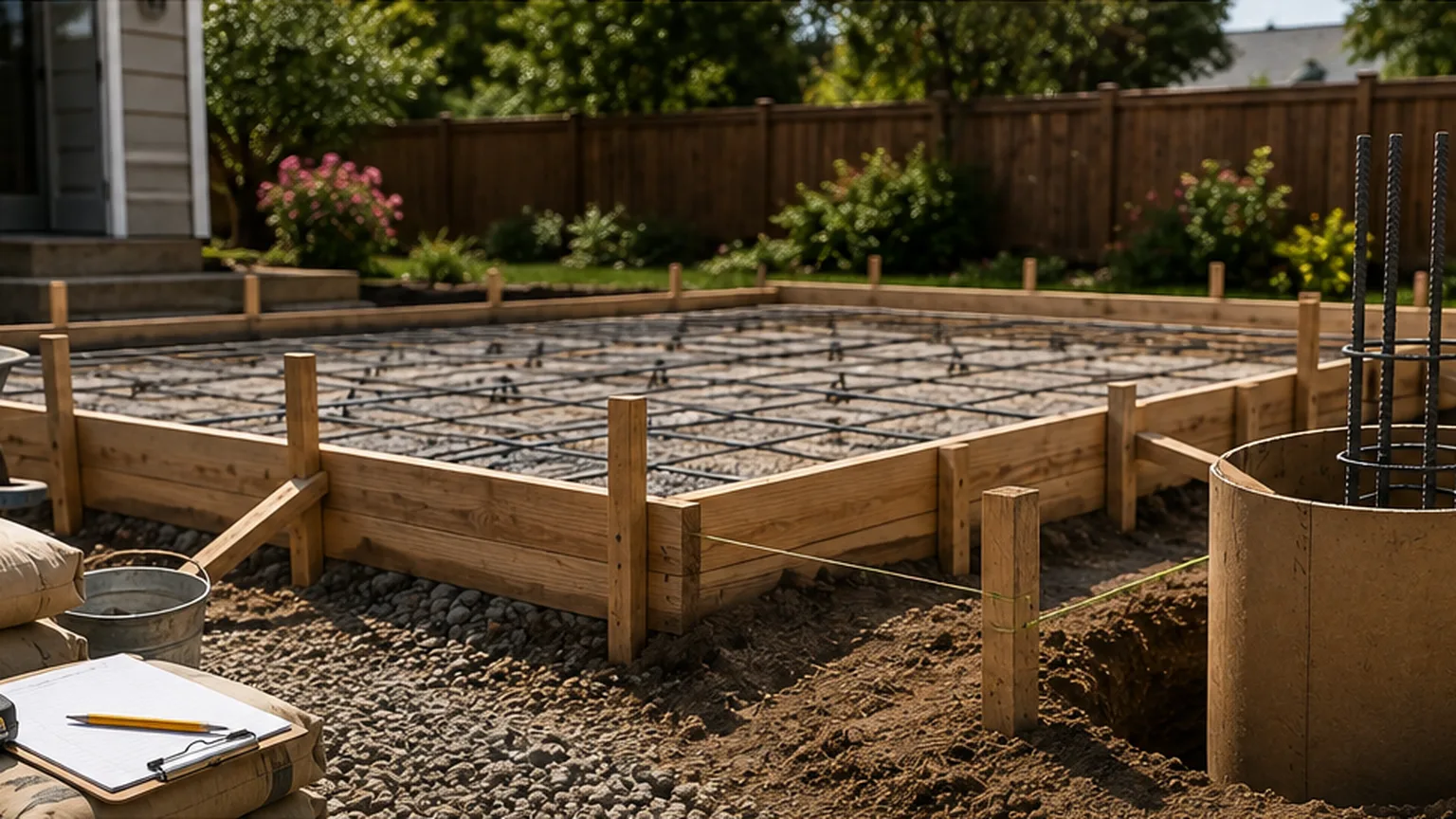
Concrete is one of those materials where a small estimating mistake becomes obvious very quickly. Order too little ready-mix and you may interrupt a pour. Buy too many bags and you are left moving, storing, or returning hundreds of pounds of material.
The useful number is not simply “how many bags do I need?” Start with volume. Once you know the volume of the slab, footing, or post holes, you can add a reasonable contingency and then decide whether bagged concrete or ready-mix makes sense.
BuildListCalc's Concrete Calculator follows that order. It currently supports slab-on-grade, continuous-footing, cylindrical post-hole, and sonotube-pier planning, with a user-set waste factor and separate bagged-mix and ready-mix paths. It is a material takeoff, not a structural or permit design.
Start with the shape you are actually pouring
Different concrete work uses different geometry.
For a rectangular slab:
Length × width × thickness = volume
For a continuous footing:
Total footing length × width × depth = volume
For round post holes or cylindrical piers:
π × radius² × depth × quantity = volume
The important part is that all dimensions must represent the concrete that will actually be placed.
A slab with a uniform 4-inch section is different from a slab with thickened edges. A simple cylindrical post hole is different from a bell-shaped footing. BuildListCalc assumes uniform slab thickness and does not model thickened edges, interior haunches, bell footings, or post displacement. Those extra shapes should not simply be hidden inside the basic dimensions.
Convert the volume to cubic yards
Residential dimensions are often measured in feet and inches, while ready-mix is normally discussed in cubic yards.
The workflow is straightforward:
- Convert inches to feet.
- Calculate cubic feet.
- Divide cubic feet by 27 to get cubic yards.
- Apply the selected waste or contingency factor.
Example: a 12 ft × 10 ft slab
Suppose the example input is:
- Length: 12 ft
- Width: 10 ft
- Thickness: 4 in
- Waste factor: 5%
First convert 4 inches to feet:
4 ÷ 12 = 0.333 ft
Then calculate the theoretical volume:
12 × 10 × 0.333 ≈ 40 cu ft
Convert to cubic yards:
40 ÷ 27 ≈ 1.48 cu yd
Apply the example 5% factor:
1.48 × 1.05 ≈ 1.56 cu yd
So the planning quantity is about 1.56 cubic yards.
The 4-inch thickness here is only an example input. It is not a recommendation for every patio, driveway, floor, or structural slab. Thickness and structural details still need to match the actual project requirements.
Treat waste as a visible assumption
A quantity estimate based on perfect geometry rarely matches every condition in the field. Excavation can vary, forms are not mathematically perfect, and some concrete may remain in equipment or be lost during placement.
That is why BuildListCalc exposes a Waste Factor (%) instead of hiding additional quantity inside the formula.
For ready-mix, NRMCA's ordering guidance says the quantity ordered should generally be about 4% to 10% greater than the estimate calculated from plan dimensions to account for contingencies.
That does not mean you should automatically calculate a BuildListCalc result with a waste factor and then add another 10% on top. Doing that could count the same contingency twice.
Use one documented quantity allowance appropriate to the project, then confirm the order with the ready-mix producer or contractor.
Bagged concrete and ready-mix solve the same volume problem differently
Once the required volume is known, procurement becomes the next decision.
The current BuildListCalc calculator treats bagged mix as the shopping-oriented path and ready-mix as a quote-first cubic-yard path. Delivery minimums, short-load charges, pumping, taxes, mix design, and placement labor are outside its ready-mix subtotal.
NRMCA likewise describes ready-mixed concrete as being sold by volume in cubic yards or cubic meters.
Bagged concrete is different because every package has a stated yield.
For example, the current technical data sheet for QUIKRETE Concrete Mix No. 1101 lists approximate yields of:
- 40 lb: 0.30 cu ft
- 60 lb: 0.45 cu ft
- 80 lb: 0.60 cu ft
Those figures apply to that specific product. Check the technical data for the concrete mix you are actually buying rather than assuming every bag with the same weight has identical coverage.
Using the 12 ft × 10 ft example above, the waste-adjusted volume was 42 cu ft. If a particular 80 lb mix yields 0.60 cu ft per bag:
42 ÷ 0.60 = 70 bags
That calculation is useful for more than shopping. Seventy 80 lb bags represent 5,600 lb of dry product before water is added. A project may be mathematically possible with bags but still be much more practical to discuss with a ready-mix supplier.
Footings: calculate quantity only after the dimensions are settled
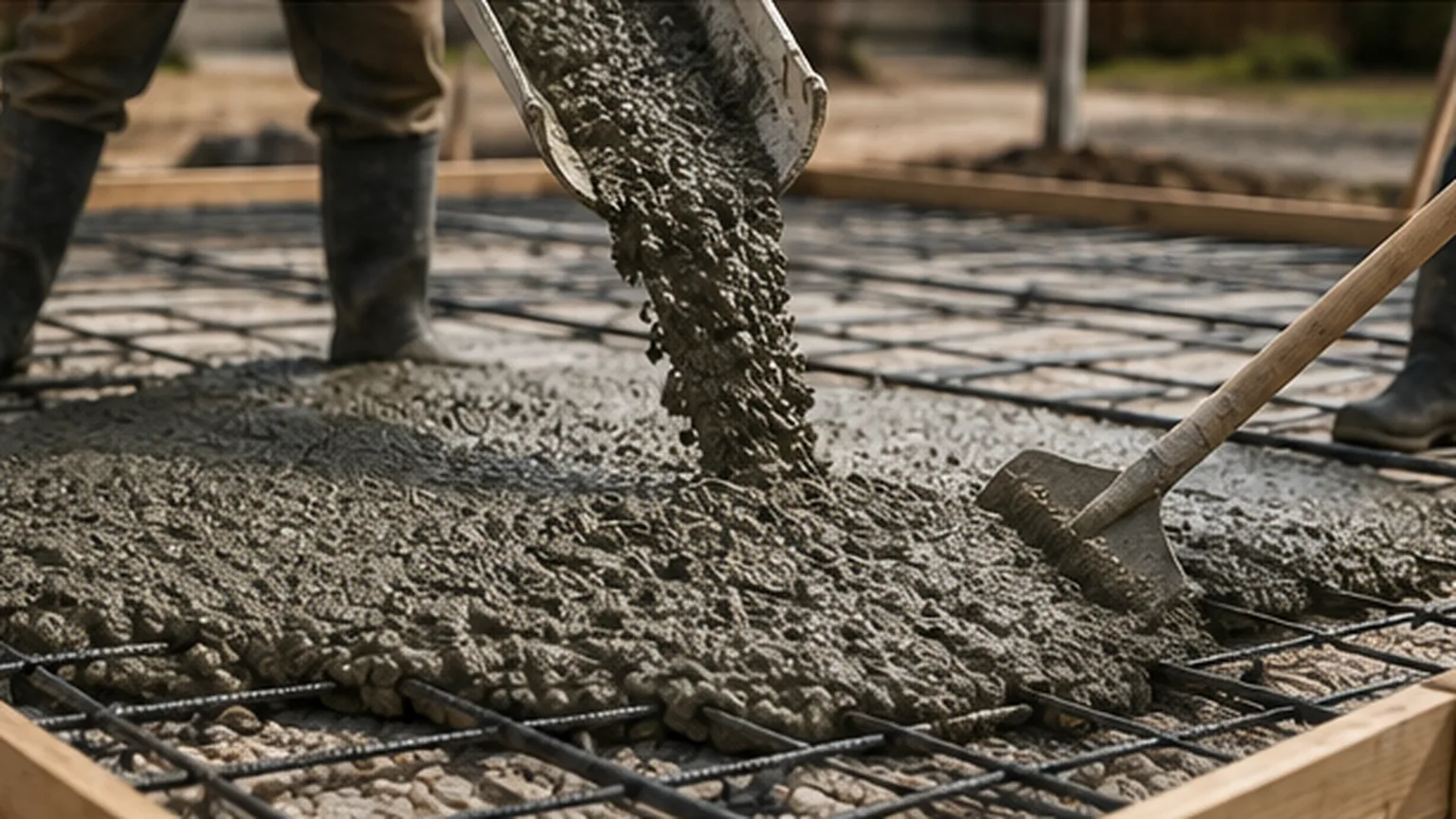
For a continuous footing, the volume calculation itself is simple.
If the example inputs are:
- Length: 24 ft
- Width: 16 in
- Depth: 12 in
- Waste factor: 5%
The theoretical volume is:
24 × (16 ÷ 12) × (12 ÷ 12) = 32 cu ft
That equals:
32 ÷ 27 ≈ 1.19 cu yd
After a 5% example allowance:
≈ 1.24 cu yd
The 12-inch depth here is only an example input chosen to match the calculator's own continuous-footing starting point. Enter a shallower continuous footing and the tool adds an advisory asking you to confirm frost depth and bearing requirements before ordering.
But the arithmetic should not be used to choose the footing dimensions.
BuildListCalc specifically leaves footing sizing, reinforcement, soil bearing, frost depth, uplift requirements, and site-specific engineering to local professional or inspector review.
In other words, the calculator can answer:
“How much concrete does this footing geometry contain?”
It does not answer:
“Is this the right footing for my building?”
That distinction matters.
Post holes: diameter changes volume faster than it looks
A round hole is calculated as a cylinder, so diameter has a squared effect on volume.
The basic formula is:
π × radius² × depth × number of holes
This is why increasing a post hole from 10 inches to 14 inches in diameter is not simply a 40% increase in concrete — it is closer to a 96% increase, because (14 ÷ 10)² ≈ 1.96.
Use the dimensions required by the actual project, then let the calculator turn those dimensions into volume.
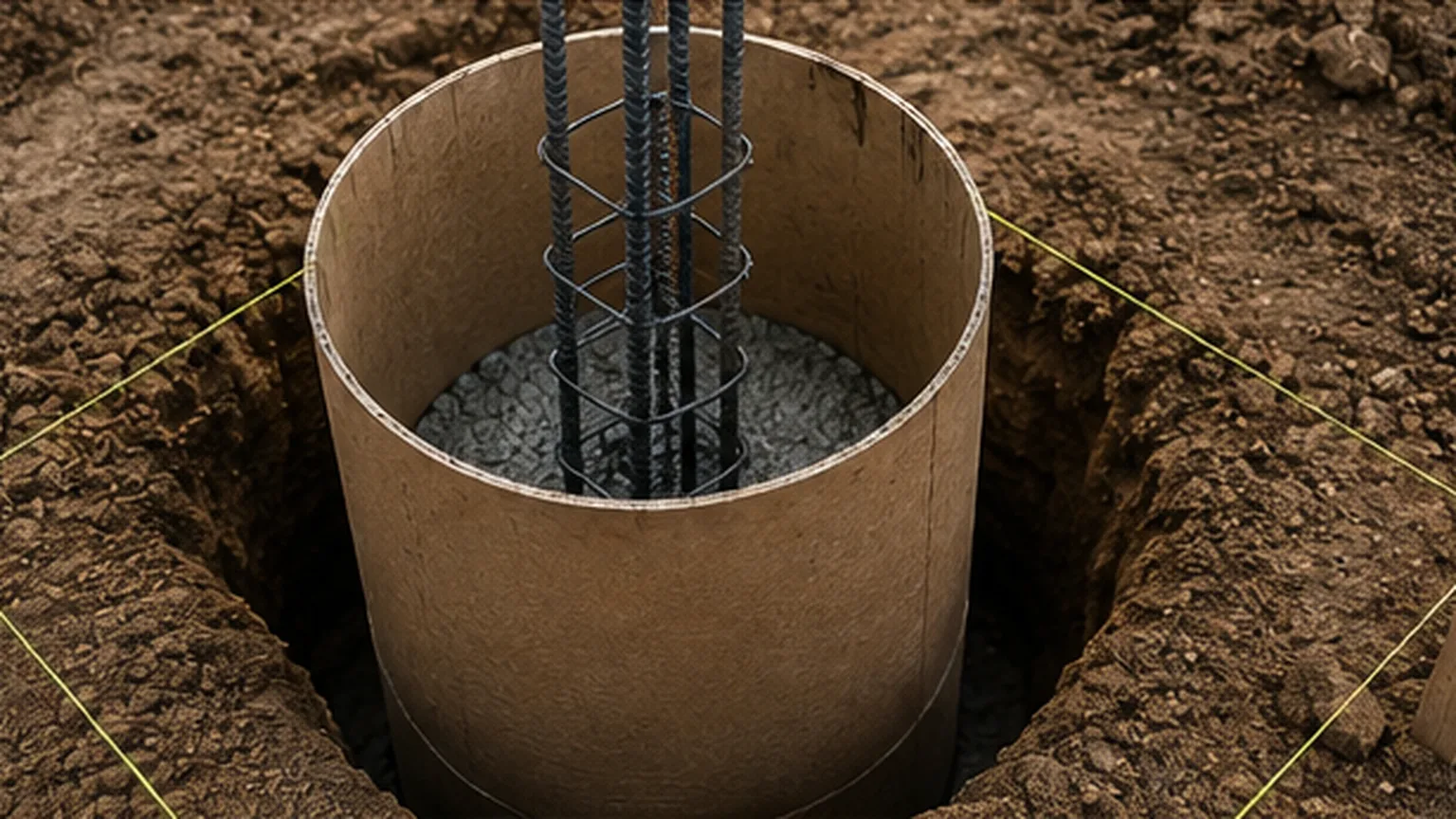
BuildListCalc's current post-hole path asks for the number of holes, hole diameter, and hole depth. Its own scope notes make clear that post displacement, bell footings, uplift design, and frost-depth compliance are not modeled.
For sonotube-style piers, the calculator similarly uses pier count, tube diameter, and total form height, while leaving footing pads and frost-depth review outside the planner.
Do not choose concrete only by quantity
A cubic-yard calculation tells you how much material the geometry contains. It does not completely specify what concrete mixture should be ordered.
NRMCA notes that ready-mix properties and mixture proportions depend on the required performance, environmental exposure, service conditions, and project requirements. The producer can help match the mixture to the stated requirements.
Before ordering ready-mix, be prepared to discuss more than yardage with the supplier or contractor.
Likewise, do not let a material calculator quietly become a structural design tool. Subgrade preparation, base material, drainage, reinforcement, formwork, joints, curing, finishing, and sawcut timing can affect the completed work even though they do not change the basic volume formula.
A better pre-order workflow
Before you buy bags or schedule a truck:
- Measure the actual pour area.
- Separate shapes that have different thicknesses, widths, depths, or diameters.
- Confirm structural dimensions from the appropriate plan, local requirement, inspector, engineer, or qualified trade where required.
- Calculate the theoretical volume.
- Apply one clearly documented waste or contingency allowance.
- Decide whether bagged concrete or ready-mix is practical for the volume and site.
- Verify the exact packaged-product yield or obtain a current ready-mix quote.
- Confirm delivery access, placement method, schedule, and any supplier requirements before ordering.
Fresh concrete also deserves basic safety planning. NRMCA warns that contact with fresh concrete can cause severe chemical burns to skin and eyes; appropriate boots, gloves, eye protection, clothing, and prompt washing after contact are important.
Use the Concrete Calculator as the quantity layer
The most useful way to use the BuildListCalc Concrete Calculator is to treat it as one layer of project planning.
Enter the geometry you have already established. Review the cubic-yard quantity and waste assumption. Compare the purchasing path. Then read the scope notes before turning the result into an order.
The calculator can make the quantity math repeatable. It cannot verify the soil, design the footing, approve the slab, choose every concrete property, or guarantee that the field dimensions match the drawing.
That is exactly where a good material estimate should stop.
Related tool: Concrete Calculator
Sources
- BuildListCalc, Concrete Calculator. Accessed August 20, 2026.
- National Ready Mixed Concrete Association, CIP 31 — Ordering Ready Mixed Concrete, revised 2023.
- QUIKRETE, Concrete Mix No. 1101 Technical Data Sheet, revised October 2022.