DIY tutorial
Deck Board Takeoff: Rows, Stock Length, Waste, Fascia, and Why Offcuts Don’t Always Reduce the Order
Turn deck dimensions into rows and stock pieces, see why 12, 16, and 20 ft boards can produce different orders, and keep fascia and offcuts visible.
BuildListCalc Editorial Team · 11 min · Published October 9, 2026 · Updated October 9, 2026 · Fact checked September 21, 2026
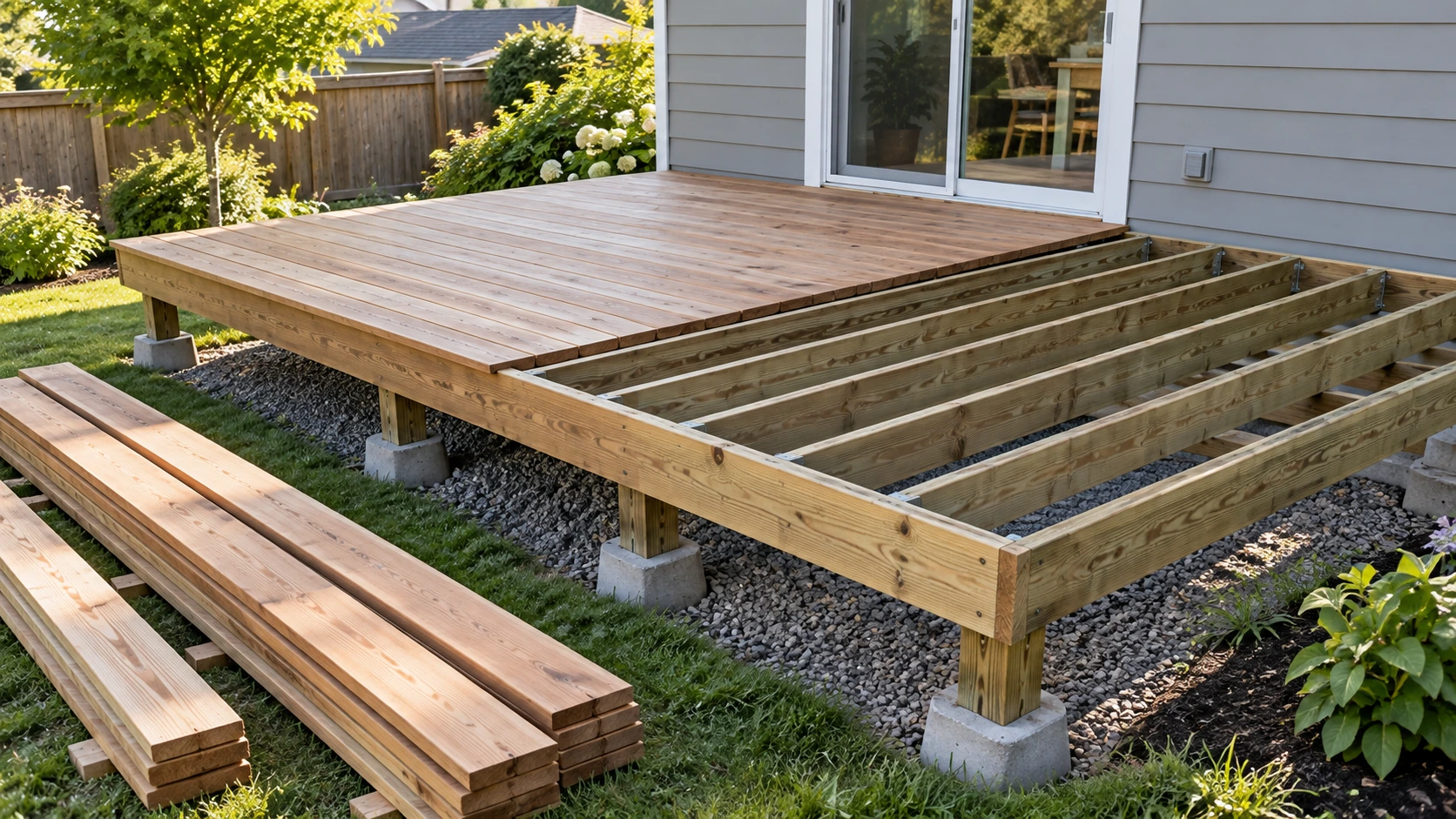
Decking is usually sold by the board, but a deck is usually measured by the square foot. The gap between those two ideas is where many takeoffs go wrong.
A 192 sq ft deck does not automatically translate into one universal board count. The number changes with board width, gap, board direction, deck run length, available stock length, layout details, waste, and whether the estimating method allows short offcuts to be reused somewhere else.
BuildListCalc's current Deck Material Calculator makes that distinction visible. Its default 16 ft × 12 ft attached-deck scenario uses 5/4×6 pressure-treated decking, 16 ft stock length, 26 decking rows, an 8% decking waste factor, and a final rounded purchase quantity of 29 deck boards. The row detail explicitly says the 16 ft run is divided by 16 ft stock, rounded up to one stock piece per row, and that offcuts are not reused across rows.1
That last sentence matters. It is a conservative purchasing rule inside the calculator's row model, not a universal field rule saying every usable cutoff must be thrown away. This guide explains how to read that model, how stock length changes the order, why board area alone can hide seam decisions, and why fascia belongs on a separate perimeter takeoff.
Planning boundary: This is a decking-material takeoff, not a structural deck design or installation approval. Confirm the accepted deck layout, joist direction and spacing, board orientation, seam/breaker-board detail, fastener system, manufacturer installation instructions, local code requirements, and actual supplier stock lengths before ordering or installing.
Start with rows, not square footage alone
The deck area is useful, but decking is laid in rows. If the boards run along the 16 ft dimension of a 16 ft × 12 ft deck, the row run is 16 ft and the rows accumulate across the 12 ft dimension.
The current BuildListCalc default uses a 5/4×6 profile with an actual width of about 5.5 in and a typical 1/8 in board gap in the planning model.1 That produces an effective row coverage of about 5.625 in.
For a 12 ft deck width:
12 ft × 12 in/ft = 144 in
A simple manual reasonableness check is:
rows ≈ ceil(144 in ÷ 5.625 in per row) = ceil(25.6) = 26 rows
That matches the calculator's current visible default result of 26 rows.1
This is why the same 192 sq ft deck can have a different board count if the profile width or board gap changes. The deck footprint did not move, but the number of rows did.
Do not treat this manual row check as an internal-code specification. It is a transparent reconstruction from the visible profile/gap inputs and observed row output so you can sanity-check the order.
Stock length changes the pieces-per-row calculation
Once the row count is known, stock length enters a second step.
For a simple row model:
stock pieces per row = ceil(row run ÷ stock length)
Then:
base stock pieces = rows × stock pieces per row
BuildListCalc's current default is the cleanest case:
- Row run: 16 ft
- Stock length: 16 ft
- Stock pieces per row:
ceil(16 ÷ 16) = 1 - Rows: 26
- Base stock pieces: 26 × 1 = 26 boards
The calculator then applies the visible 8% decking waste factor and rounds to a whole-board purchase quantity:
ceil(26 × 1.08) = ceil(28.08) = 29 boards
That reproduces the observed default material row: 29 5/4×6 deck boards.1
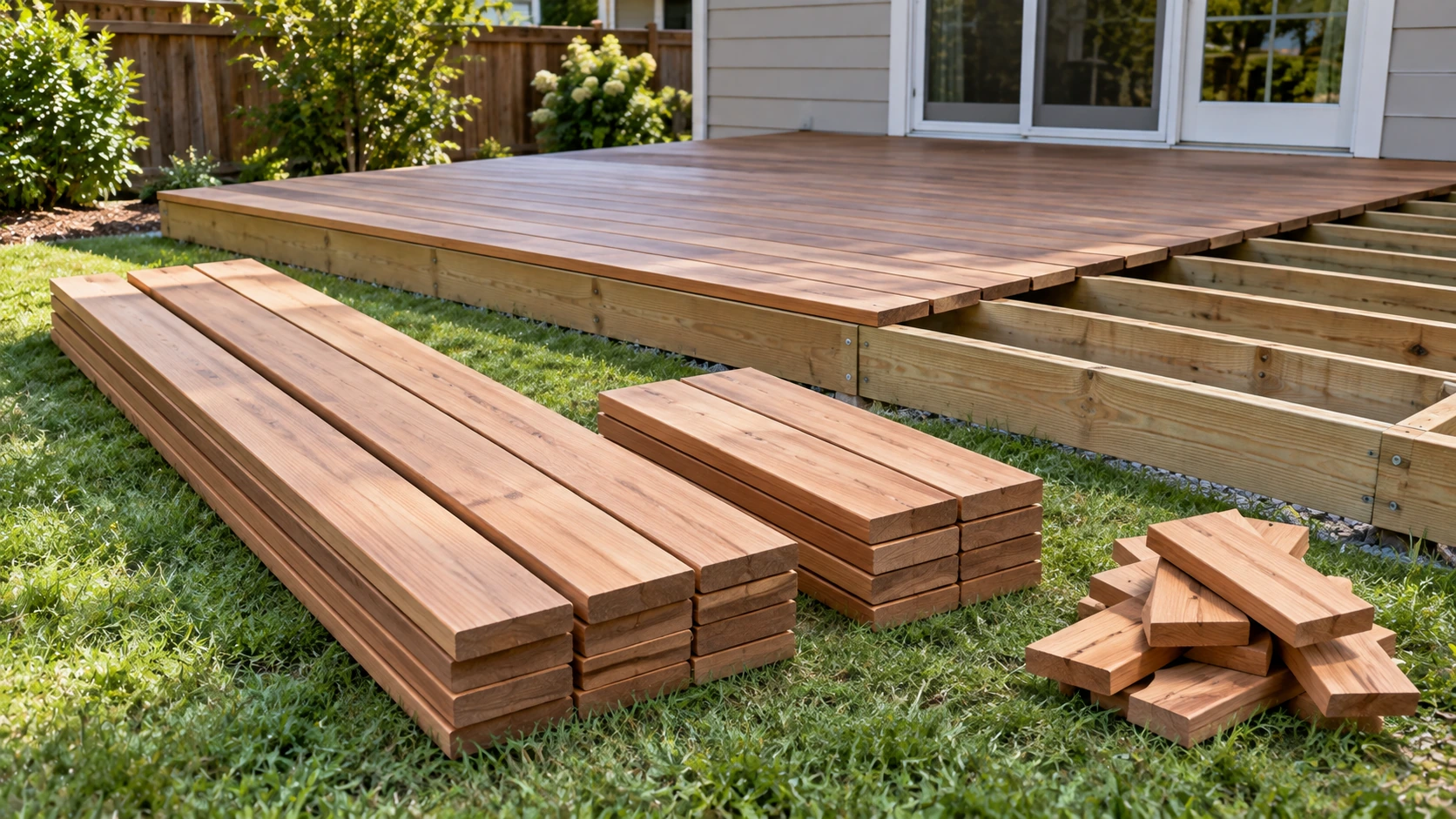
Manual comparison: what if the same 16 ft row used 12 ft stock?
Now keep the deck, profile, 26 rows, and 8% waste unchanged, but manually substitute a 12 ft stock length.
This is a manual comparison, not an observed BuildListCalc custom output.
Under the calculator's stated row-by-row rule that offcuts are not reused across rows:
pieces per row = ceil(16 ft ÷ 12 ft) = 2
So the base stock count becomes:
26 rows × 2 pieces per row = 52 boards
Applying the same 8% demonstration waste:
ceil(52 × 1.08) = ceil(56.16) = 57 boards
The apparent jump from 29 to 57 boards looks extreme because the model treats every 16 ft row as needing two independent stock pieces and does not pool the leftover length from one row into another row.
For a 16 ft row cut from two 12 ft boards, one piece may provide 12 ft and the second may provide the remaining 4 ft, leaving a substantial cutoff. In a real job, whether that cutoff can be reused depends on the layout, seam locations, board condition, color/appearance requirements, framing support, fastening system, and the selected manufacturer's installation rules. The calculator intentionally does not assume that optimization for you.
That is the right way to read the 57-board manual result: not as proof that 57 boards are always physically necessary, but as the output of a conservative no-cross-row-offcut-reuse purchasing model.
Longer stock does not always reduce the board count
The opposite case is also useful.
Trex's current decking product information shows common composite deck-board stock lengths of 12 ft, 16 ft, and 20 ft for several profiles.3 That gives a traceable example of why the next longer stock size does not automatically reduce the piece count.
For the same 16 ft row using 20 ft stock:
pieces per row = ceil(16 ÷ 20) = 1
The row still needs one stock board. In the same no-cross-row-reuse model:
26 rows × 1 = 26 base boards
With 8% waste:
ceil(26 × 1.08) = 29 boards
So 16 ft stock and 20 ft stock can both produce 29 boards in this particular row model. The 20 ft board leaves more nominal offcut per row; it does not reduce the number of stock pieces because each row already fits on one 16 ft board.
That does not mean 20 ft stock is a bad choice. It may affect seam avoidance, appearance, availability, delivery, handling, price, and layout. The point is narrower: stock length changes purchase count only when it changes how many stock pieces are needed per row.
Offcut reuse is a layout decision, not free material
It is tempting to add all leftover linear feet together and subtract them from the order. That can understate the real purchase quantity.
An offcut is useful only if it fits another required location with the correct:
- length;
- board profile and edge condition;
- appearance/color requirements;
- seam location;
- framing/support condition;
- fastening system;
- manufacturer-required gapping and end treatment.
Trex's current butt-joint guidance illustrates why seams are not merely a linear-foot equation. Its system-specific instructions describe butt joints as a detail that requires correct end-to-end gapping and proper board support/fastening; Trex also offers specialized butt-joint hardware for certain grooved boards.5 The same manufacturer separately shows breaker-board framing as another way to organize runs that exceed available board lengths.6
Those details are specific to the selected Trex systems and are not universal instructions for every decking product. Their value here is to show that creating a seam can change the installation detail. A leftover piece that has enough linear length is not automatically a valid replacement for a full board in another row.
For purchasing, BuildListCalc's decision not to reuse offcuts across rows keeps the result conservative and auditable. For final optimization, review the actual cut plan after the deck layout and installation system are fixed.
Waste belongs after the row/stock calculation
Waste should not be used to hide an incorrect pieces-per-row calculation.
In the current BuildListCalc default, the visible decking row says:
- 26 rows × 1 piece per row
- Pattern uplift: 0%
- Waste: 8%
- Final rounded purchase quantity: 29 boards1
That sequence matters. First determine how many stock pieces the row model requires. Then apply the explicit waste factor. Then round to a whole purchase unit.
For the default:
ceil(26 rows × 1 piece/row × 1.08) = 29 boards
Do not reverse the logic by taking deck square footage, adding an arbitrary percentage, and dividing by a board's face area if the actual purchase problem is controlled by row length and stock pieces.
A surface-area check can still be useful for reasonableness, but the row/stock model is what exposes the seam and stock-length problem.
Board direction can change the purchasing problem
A 16 ft × 12 ft rectangle has the same area regardless of board direction, but board orientation swaps the run and row dimensions.
If boards run along the 16 ft dimension, the row run is 16 ft and the rows accumulate across 12 ft.
If the accepted design rotates the boards 90 degrees, the row run becomes 12 ft and rows accumulate across 16 ft. The area is still 192 sq ft, but the row count, pieces-per-row calculation, seam locations, and potentially the waste pattern all change.
That is why board direction should be settled before you treat the material list as supplier-ready. It can also change framing/support requirements, so do not rotate decking purely to reduce material count without checking the actual deck design and manufacturer requirements.
Fascia is a separate perimeter takeoff
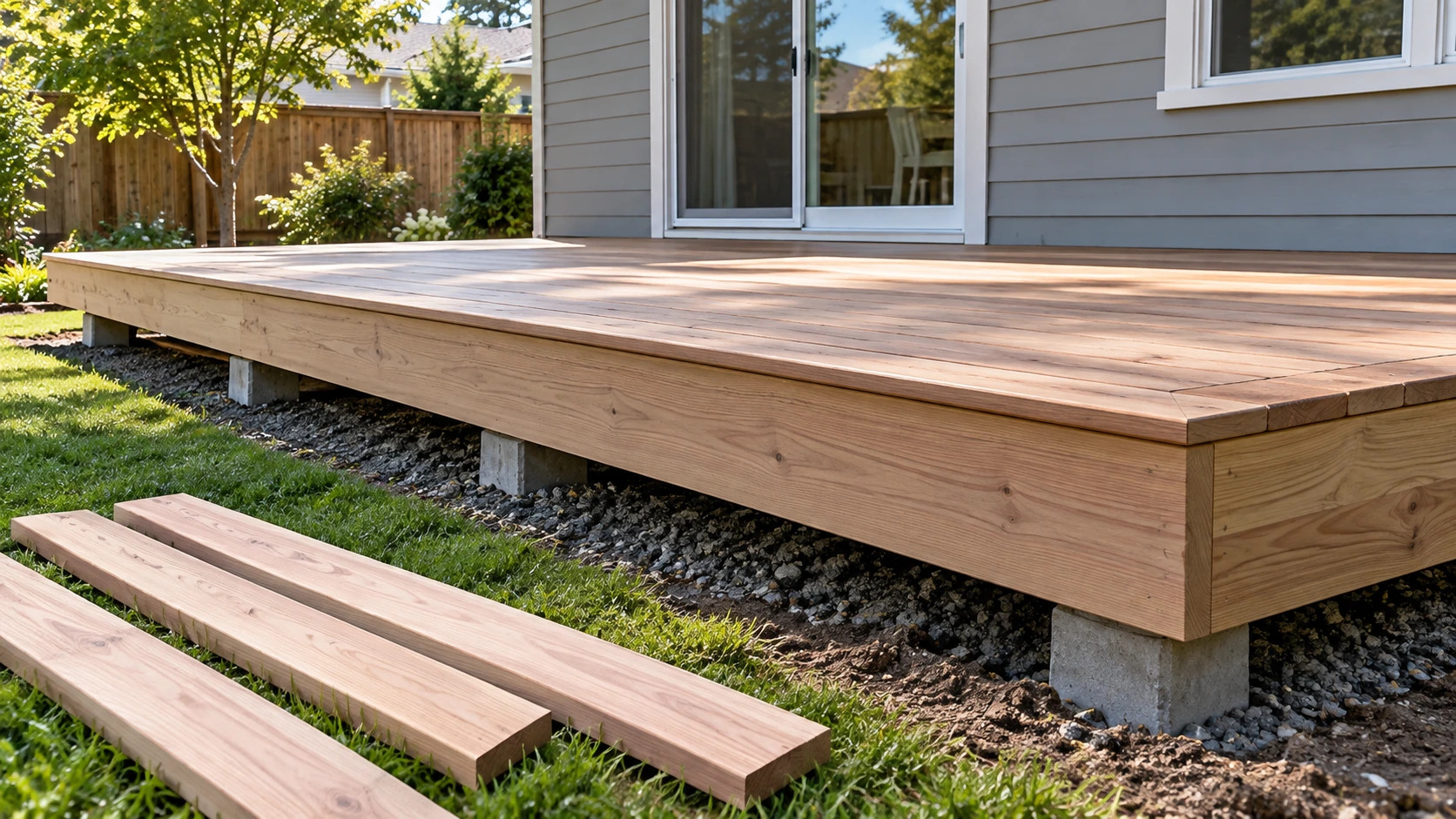
Fascia is not another field row. It follows the exposed deck edge.
The current BuildListCalc default separately lists 3 pressure-treated fascia boards and describes their coverage basis as the exposed deck perimeter with trim waste, using a 5% fascia waste factor.1 That line is independent from the 26 decking rows and 8% field-decking waste.
The generic planning form is:
fascia pieces = ceil(exposed fascia length × (1 + trim allowance) ÷ fascia stock length)
But use the actual product length. Trex's current fascia product guide, for example, lists its fascia boards at 12 ft long in the referenced product family.4 That is a manufacturer-specific example, not a claim that every wood or composite fascia product is 12 ft long.
Corners, stairs, picture-frame borders, interrupted edges, mitered ends, and product-specific fastening can all affect the real fascia order. Keep fascia on its own material line so field-decking offcuts do not silently get counted as finished perimeter material without review.
The same deck area can support several valid purchasing strategies
For a simple rectangular deck, you may encounter several different purchasing paths:
1. Full-length rows
Choose stock that spans each row without an end joint. This can simplify the visible field but may create longer offcuts, higher delivery constraints, or higher unit prices.
2. Shorter stock with planned seams
Use more than one board per row with a deliberate seam layout. This can make stock easier to source or handle, but it adds joint planning and can change framing/fastening details.
3. Breaker-board or border layout
A breaker board can divide long runs into shorter fields. Trex's current framing guidance shows this as one manufacturer-specific approach when a deck run exceeds available board lengths.6 It is a layout decision, not merely a waste-reduction trick.
4. Offcut optimization after layout is fixed
A cut schedule may reuse some offcuts in short rows, stair components, borders, or other compatible locations. Do that only after confirming that the piece is actually suitable for the new location. BuildListCalc's default row model deliberately does not assume this optimization.
How to use the Deck Material Calculator without over-reading the result
For a deck-board-focused takeoff:
- Open the Deck Material Calculator.
- Enter the actual deck length and width.
- Confirm board direction in the accepted layout before interpreting rows.
- Choose the board profile/material that matches the intended system.
- Enter the real board gap where the tool supports it.
- Enter a stock length that is actually available from your supplier/product line.
- Read the decking row details: row count, pieces per row, waste, and final rounded quantity.
- Treat the calculator's no cross-row offcut reuse rule as a conservative purchasing assumption, not as an installation prohibition.
- Review fascia as a separate exposed-perimeter line.
- If the row requires seams, breaker boards, picture framing, or special fastening, verify the deck design and manufacturer instructions before buying.
- Recheck local availability and delivery constraints for long stock before treating the list as final.
The current calculator also estimates framing, footings, guards, stairs, ledger materials, connectors, and fasteners, but those assemblies should not be altered merely to make the decking board count look better.1
Worked-example recap
| Item | Observed default or manual comparison |
|---|---|
| Deck footprint | 16 ft × 12 ft = 192 sq ft |
| Decking profile | 5/4×6, about 5.5 in actual width |
| Planning gap | 1/8 in |
| Effective row coverage check | about 5.625 in |
| Observed rows | 26 |
| Observed stock length | 16 ft |
| Observed pieces per row | 1 |
| Base board count | 26 |
| Observed decking waste | 8% |
| Observed final purchase quantity | 29 boards |
| Manual 12 ft stock comparison | 26 × 2 × 1.08 = 56.16 → 57 boards |
| Manual 20 ft stock comparison | 26 × 1 × 1.08 = 28.08 → 29 boards |
| Current default fascia line | 3 fascia boards, separate 5% trim waste |
The 29-board result is observed current BuildListCalc output for the default 16 ft stock scenario. The 57-board and 29-board stock-length comparisons are manual examples using the calculator's stated row-by-row/no-cross-row-offcut-reuse logic; they were not submitted as custom live-tool scenarios.
Final check before ordering
A strong deck-board takeoff makes the stock-length assumptions visible.
Know the board direction. Know the row count. Know the row run. Use a stock length your supplier actually sells. Calculate pieces per row before waste. Keep offcut reuse conservative until the cut and seam layout is real. Keep fascia on its own perimeter line. Then round to whole purchase boards.
Most importantly, do not confuse a material-optimization idea with an approved deck detail. Seams, breaker boards, fastening, support, gapping, and structural layout belong to the selected decking system, the accepted project design, manufacturer instructions, and local review.
That gives you a board order you can explain—and revise—without pretending that square footage alone solved the deck.
Sources
- BuildListCalc, Deck Material Calculator, accessed September 21, 2026. https://buildlistcalc.com/projects/deck-builder
- BuildListCalc, Calculadora de materiales para deck, accessed September 21, 2026. https://buildlistcalc.com/es/projects/constructor-de-deck
- Trex, Trex Decking for Professional Builders, accessed September 21, 2026. https://www.trex.com/professionals/products/decking/
- Trex, Trex Fascia Product Guide, accessed September 21, 2026. https://www.trex.com/professionals/products/fascia/
- Trex, How to Install a Butt Joint/Seam with the Trex Hideaway Butt Joint Clip, accessed September 21, 2026. https://www.trex.com/academy/how-to-guides/all-guides/how-to-install-a-butt-joint-seam-with-the-trex-hideaway-butt-joi/
- Trex, How to Install and Space Deck Joists for Composite Decking, accessed September 21, 2026. https://www.trex.com/academy/how-to-guides/all-guides/how-to-install-deck-joists/