Site Guide
Concrete Bags vs. Ready-Mix: How to Choose the Right Buying Path for a Small Residential Pour
Compare bagged concrete and ready-mix by volume, bag count, placement continuity, truck access, supplier logistics, and project requirements instead of relying on a fake cubic-yard cutoff.
BuildListCalc Editorial Team · 8 min · Published September 5, 2026 · Updated September 5, 2026 · Fact checked August 21, 2026
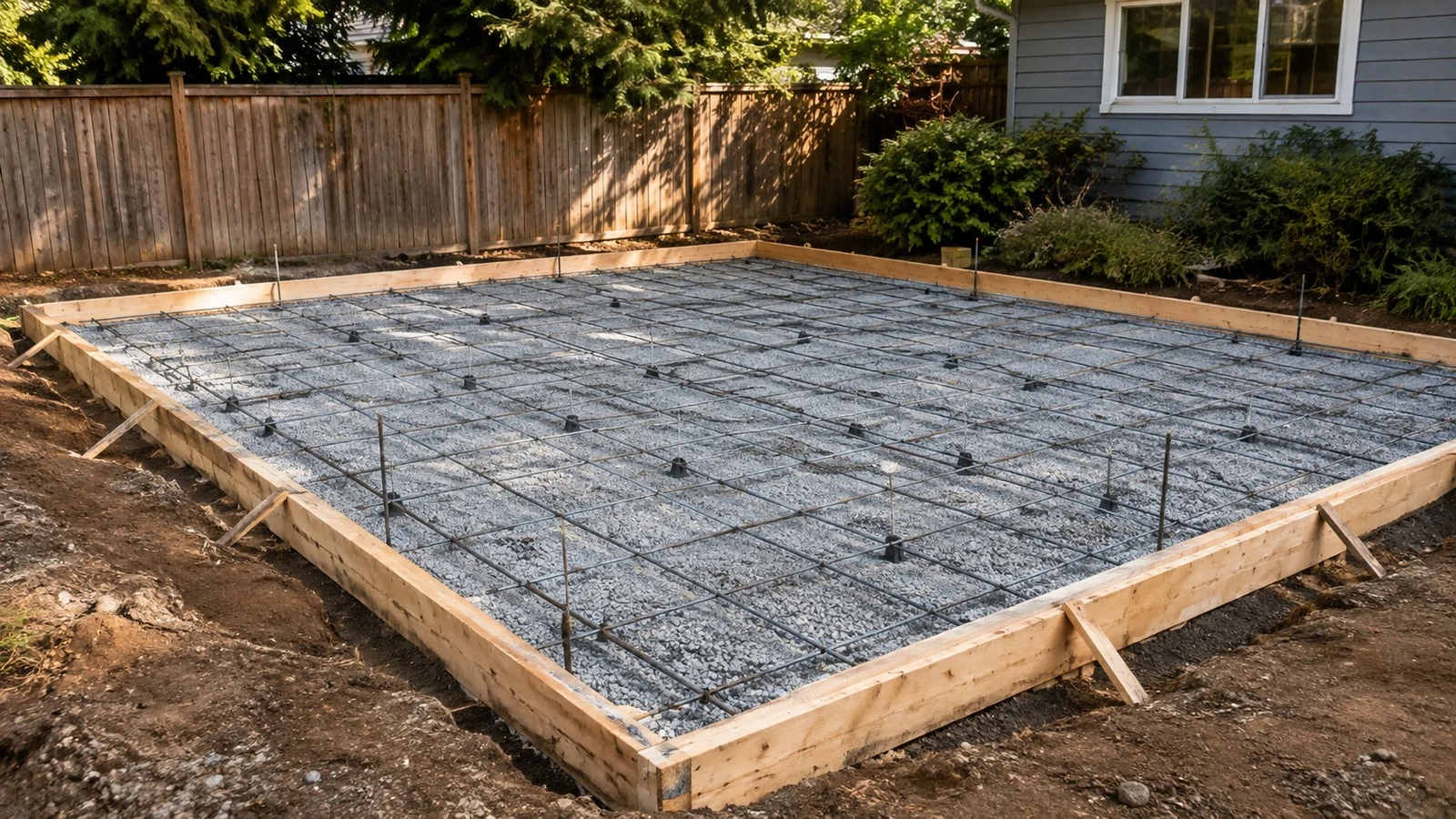
For a small slab, footing, equipment pad, or set of post holes, the first concrete question is usually not strength or finish. It is simpler: Do you buy packaged concrete mix, or schedule ready-mix delivery?
There is no universal cubic-yard cutoff. The right buying path depends on total volume, access, how fast the concrete must be placed, how many people and mixers are available, the mix requirements, and what a local ready-mix producer charges for delivery and small loads.
BuildListCalc's Concrete Calculator separates those two procurement paths on purpose. The bagged path converts required volume into whole bags. The ready-mix path keeps the result in cubic yards and leaves delivery minimums, short-load fees, pumping, tax, mix design, and placement labor to the supplier quote.
1. Calculate volume before comparing prices
For a simple rectangular slab, volume starts with length × width × thickness. BuildListCalc converts the result to cubic yards and applies the waste factor you enter. For footings and post holes, the geometry changes, but the principle does not: determine the required volume first, then decide how to buy it.
Do not let the purchasing method determine the slab design. Thickness, reinforcement, subgrade, frost protection, joints, drainage, soil support, and structural requirements come from the actual project and local conditions. The calculator explicitly treats those items as planning or review scope rather than permit-ready design.
What one cubic yard looks like in bags
A cubic yard contains 27 cubic feet. QUIKRETE technical data used for this guide lists approximate yields of 0.60 cu ft for an 80 lb bag, 0.45 cu ft for a 60 lb bag, and 0.30 cu ft for a 40 lb bag. Those yields match the planning conversions shown in BuildListCalc.
Using those published yields, and rounding up to whole bags before adding any project waste allowance:
| Concrete volume | 80 lb bags | 60 lb bags | 40 lb bags |
|---|---|---|---|
| 0.25 cu yd | 12 | 15 | 23 |
| 0.50 cu yd | 23 | 30 | 45 |
| 0.75 cu yd | 34 | 45 | 68 |
| 1.00 cu yd | 45 | 60 | 90 |
That table is not a purchasing recommendation. It is a workload reality check. Forty-five 80 lb bags are about 3,600 lb of dry material before water is added, and every bag still has to be moved, mixed, discharged, placed, consolidated, struck off, and finished while the pour remains workable.
2. Bagged concrete works best when control and access matter more than speed
Bagged concrete can be an excellent choice for small, scattered, or hard-to-access pours. It is especially practical when the project can be mixed in manageable batches and the work does not require a large continuous placement.
Typical bag-friendly situations include:
- a few fence or pergola post holes;
- a small equipment pad;
- a short repair section;
- isolated footing pockets;
- a location a concrete truck cannot reach; or
- a project where the homeowner wants to buy material gradually and store it dry before placement.
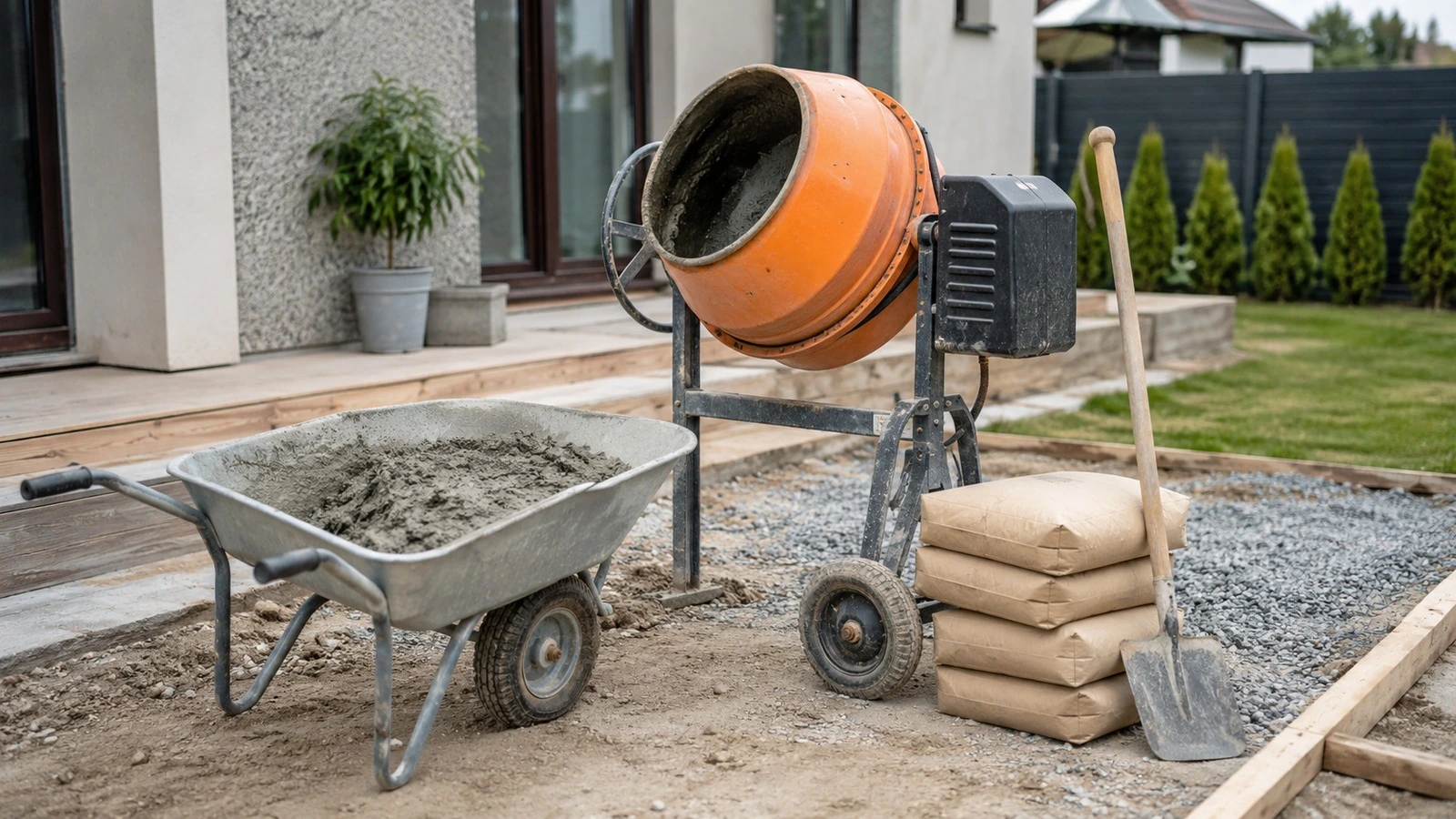
Caption: Bagged mix gives you control over small batches, but the labor grows quickly as bag count rises.
The hidden cost of bags is handling and cycle time
A bag price is easy to see. The harder number is the labor needed to turn dozens of bags into one consistent placement.
Ask these questions before choosing bags:
- How many bags must be lifted from delivery point to mixer?
- Can the mixer handle the bag size and batch volume safely?
- How many batches will be required?
- Can each batch be placed fast enough to avoid creating unwanted cold joints or inconsistent finishing conditions?
- Is there enough clean water and a reliable mixing setup at the work area?
Packaged concrete technical sheets also matter. They provide the manufacturer's water range, mixing procedure, application limits, and yield. Do not improvise by adding extra water simply to make the mix easier to move; excess water can reduce concrete quality. Follow the selected product's data sheet.
3. Ready-mix becomes attractive when continuity and production rate matter
Ready-mixed concrete arrives in a fresh, unhardened state and is sold by volume. NRMCA guidance describes ready-mix as a product that should be ordered around project-specific requirements and scheduled so the placement crew is ready when the truck arrives.
For a residential pour, ready-mix may make more sense when:
- the bag count is high enough that manual or small-mixer production will be slow;
- the slab or footing should be placed continuously;
- several workers are available to place and finish quickly;
- a truck can reach the discharge area, or a pump/conveyor has been planned;
- the required concrete properties are better handled through a producer-designed mix; or
- the time saved is worth more than a small-load delivery premium.
NRMCA's current CIP 31 — Ordering Ready Mixed Concrete emphasizes that concrete is a perishable construction material and that the crew should be ready before delivery. It also tells purchasers to communicate the placement location, estimated delivery rate, access conditions, and project requirements to the producer.
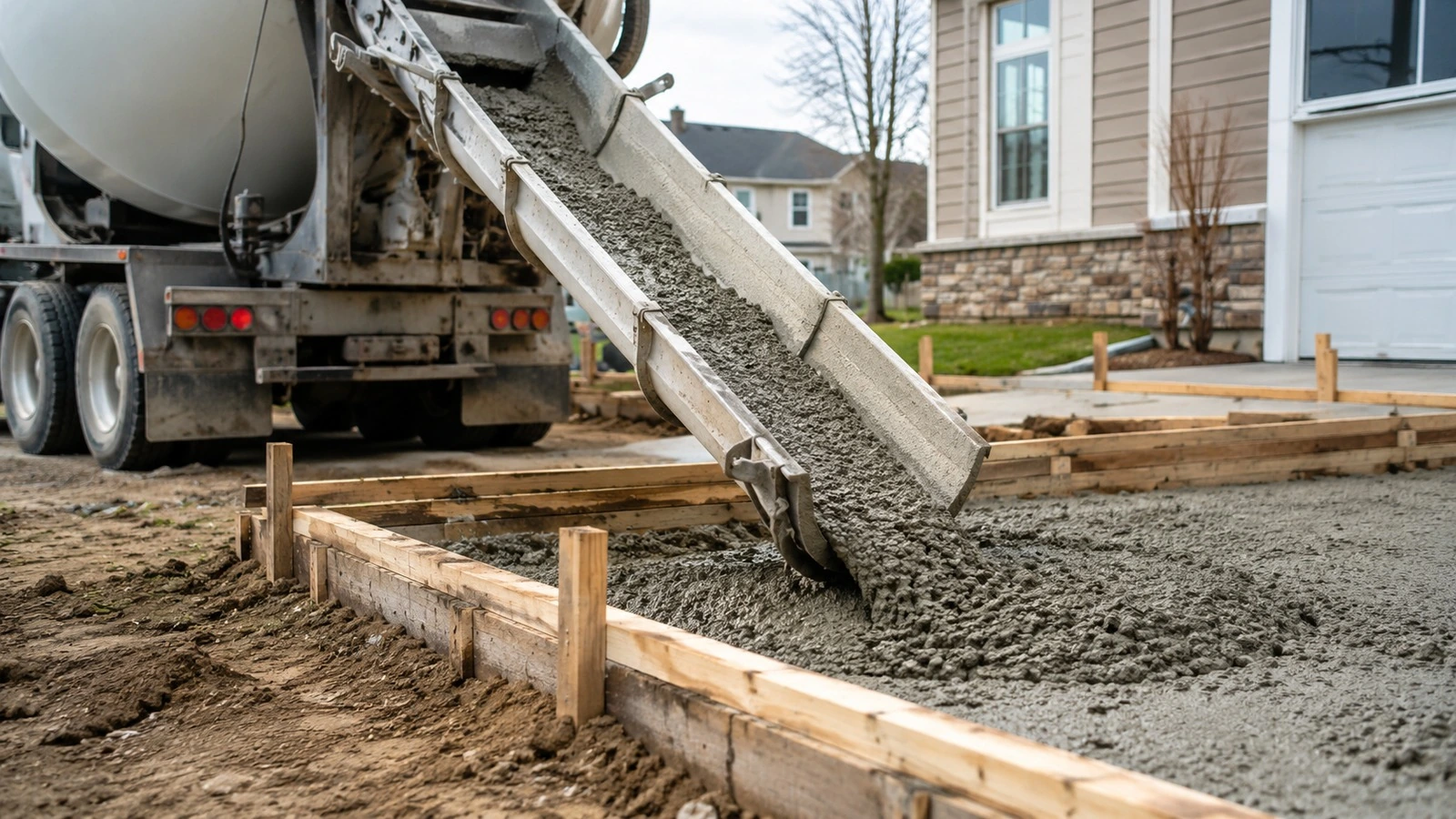
Caption: Ready-mix solves the mixing-volume problem, but it creates a scheduling, access, discharge, and crew-readiness problem that must be solved before the truck arrives.
4. Do not assume the truck can simply back into the yard
Truck access is a major decision point. NRMCA notes that a loaded concrete truck can weigh about 80,000 lb and may not be able to maneuver over loose soil, residential curbs, or light-duty paths. That does not mean every residential delivery requires a pump, but it does mean you should discuss access with the producer rather than improvising on delivery day.
Before ordering, confirm:
- street and driveway access;
- overhead wires and low branches;
- turning room;
- pavement, curb, and soil conditions;
- discharge distance from truck to forms;
- whether wheelbarrows, powered buggies, conveyor, or pump are needed.
If new excavation is part of the project, contact 811 before digging and follow the state-specific notice and positive-response process before breaking ground.
5. Ready-mix pricing is more than "price per yard"
A homeowner may see a cubic-yard quote and assume the comparison is simply:
bags total cost versus ready-mix yardage cost.
BuildListCalc intentionally keeps delivery minimums, short-load fees, mix design, pumping, tax, and placement labor outside its ready-mix subtotal. Producer-specific quotes can include other project-specific charges, so treat ready-mix as quote-first.
That means a small job can produce two opposite outcomes:
- Bags may be cheaper in cash but expensive in labor and fatigue.
- Ready-mix may cost more per cubic yard on a small order but finish the placement much faster and more consistently.
The correct comparison is total installed effort and logistics, not just material unit price.
6. The mix specification still matters
Choosing ready-mix does not mean ordering "one yard of concrete" with no other information. NRMCA states that the producer develops mixtures around performance requirements supplied by the purchaser or project specifications. Environmental exposure, required strength, placement method, air content where freezing exposure applies, aggregate size, workability, and other properties may affect the mixture.
For packaged concrete, the product itself already has a manufacturer-defined formulation and installation range. For ready-mix, the producer needs enough project information to recommend or supply the correct mixture.
For structural footings, elevated elements, heavily loaded slabs, freeze-thaw exposure, retaining work, or permit-controlled construction, the project designer, contractor, or local AHJ should define the requirements before the order is placed. Do not use a generic strength grade from habit as a substitute for the project requirements.
7. Plan quantity conservatively—but do not hide uncertainty inside a huge waste factor
NRMCA's CIP 31 recommends ordering somewhat more concrete than the calculated plan quantity to account for contingencies, while also warning against excessive over-ordering and small cleanup loads. BuildListCalc exposes the waste factor so the user can see what is being added rather than silently padding the total.
For a DIY planner, the better sequence is:
- Measure the actual geometry carefully.
- Confirm thickness and footing dimensions from the project requirements.
- Use the Concrete Calculator to calculate adjusted volume.
- Inspect the bag-equivalent count as a labor benchmark.
- Get a ready-mix quote for the same adjusted volume.
- Ask the supplier what minimum, short-load, delivery, waiting, and access policies apply.
- Choose the path that the crew and site can actually execute.
If the measured geometry is uncertain, fix the measurement problem instead of covering it with an extreme waste percentage.
8. A practical decision rule
Instead of a fake universal threshold, use three questions:
Question 1: Can you physically process the bag count?
If the answer is comfortably yes, bagged mix remains viable. If the count implies dozens of heavy bags and many mixer cycles, ready-mix deserves a quote.
Question 2: Does the placement need to be continuous?
Small isolated post holes are forgiving. A larger slab with a finish surface is much less forgiving of slow, inconsistent batching. As continuity becomes more important, ready-mix becomes more attractive.
Question 3: Can the site accept a truck or alternative placement method?
If access is poor, bagged mix may win even at a higher labor cost. If access is excellent and the crew is ready, ready-mix may be the cleaner path even for a relatively modest volume.
Safety and code boundary
Fresh concrete and cementitious materials can cause serious skin and eye burns. NRMCA recommends rubber boots, gloves, protective eyewear, clothing, and prompt washing after contact. Follow the safety data for the product you buy.
This article is about procurement planning, not slab engineering. Local code, frost depth, soil, reinforcement, drainage, subgrade, control joints, curing, accessibility, and structural loads can change the correct concrete system. Confirm those requirements before buying either bags or ready-mix.
Sources and verification
Fact-checked: August 21, 2026.
- BuildListCalc, BuildListCalc Blog. Accessed August 21, 2026.
- BuildListCalc, Concrete Calculator. Accessed August 21, 2026.
- QUIKRETE, Concrete Mix Technical Data Sheet, Product No. 1101. Accessed August 21, 2026.
- National Ready Mixed Concrete Association, CIP 31 - Ordering Ready Mixed Concrete. Accessed August 21, 2026.
- U.S. DOT Pipeline and Hazardous Materials Safety Administration, 811 Day. Accessed August 21, 2026.
Related tool: Concrete Calculator
Important: Model standards, local codes, project specifications, and supplier policies vary. Confirm the final concrete design and delivery requirements for the actual job site.